
⚠️ Opening from X (Twitter)? In-app browsers often block PDF downloads. Tap ••• → Open in Browser (Safari / Chrome) or copy the link to open outside X.
First Edition v1.0 · 17 Chapters · 434 Pages

Build real software with AI.
Without shipping slop.

A practical guide for founders, students, operators, and builders who want to turn AI-generated drafts into software real people can actually trust.

“AI made code cheap and judgement scarce. The tool has changed, the responsibility has not. You still decide what to build, what ‘working’ means, and what you are willing to put in front of another person.”
On X mobile? Tap ••• → Open in Browser or if PDF download is blocked in-app.
By Antony Kariuki · Google Drive Mirror ↗ · Free Digital Edition
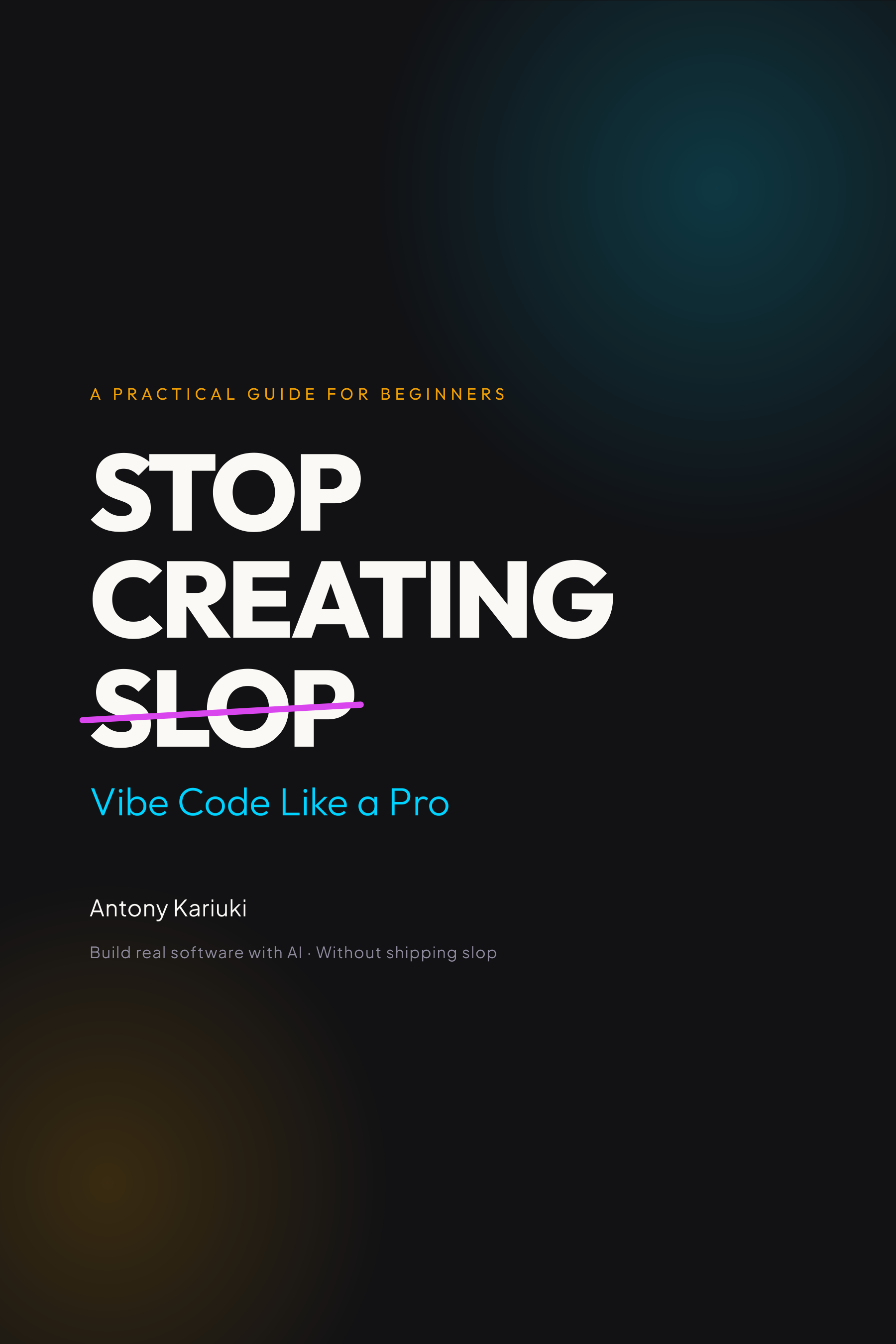
STOP CREATING SLOP: Vibe Code Like a Pro book cover
● Full 17-chapter web reader + instant PDF download
Chapter 02 · The Core Premise

Producing code is not engineering a product.

Vibe coding was originally scoped to throwaway weekend experiments. When you ship unreviewed AI output to real users, you don’t build a product — you create slop.

Slop · Unreviewed AI Output

The “It Runs, So It’s Fine” Trap

  • ✕
    One-line vague prompts: Asking for “an ordering app” and hoping the AI guesses what “done” means.
  • ✕
    Clicking “Accept All”: Merging 5-file diffs without reading logic, secrets, or deployment config changes.
  • ✕
    The padlock illusion: Assuming HTTPS alone protects against broken access control and SQL injection.
  • ✕
    Demo ≠ Production: Confusing something that works once on your laptop with software users can rely on.
Pro · Engineered AI Collaboration

Vibe Code Like a Professional Builder

  • ✓
    Specification before code: Writing 1-page problem specs and 3–5 testable Given-When-Then criteria first.
  • ✓
    The Diff Discipline: Inspecting every changed line and triaging output as Safe, Needs Review, or Reject.
  • ✓
    AuthN ≠ AuthZ + Server Validation: Enforcing object-level ownership checks, hashed passwords, and env secrets.
  • ✓
    No deploy on red: Running unit/integration tests before every deploy, with Git safety nets and rollback plans.
Marketable Extracts · Inside the Pages

Ideas built to outlast today’s tools.

Every concept is illustrated through Mifugo Market, a fictional Nairobi fresh-produce ordering platform built end-to-end from first principles to production.

Glowing bridge above fractured wireframe supports
Ch. 2 · Slop Detector

“It runs on my screen” is not a safety standard.

“A bridge that looks solid from a distance can still collapse under load. Behind a working-looking surface, AI-generated code can contain hardcoded passwords, missing input validation, broken access controls, or silent data loss.”

Stainless-steel kitchen inspection pass
Ch. 2 · Mental Model

Fast food without an inspector in the kitchen.

“Think of AI-generated code like fast food prepared without an inspector in the kitchen. It looks like a meal. It tastes fine at first. But without inspection, you cannot tell whether something will make you sick later.”
Code diff glass layers under inspection beam
Ch. 8 · The Diff Discipline

Stop clicking “Accept All.”

“Learning to read and review a diff is the skill that separates a builder who directs AI from a prompt-giver who hopes for the best. If you cannot explain the code, you do not accept it.”
Chaotic threads transforming into structured blueprint
Ch. 5 · Specification

A vague prompt produces slop.

“AI coding assistants are powerful, but they are literal. They build exactly what you ask for — and nothing more. Without acceptance criteria, there is no definition of success.”
Glass security vault with open side panel
Ch. 11 & 13 · Security

That browser padlock doesn’t make it secure.

“HTTPS only protects data in transit. It does not fix broken access control, injection, or excessive data collection. Authentication is who you are; authorization is what you may do. They are separate.”
Four ascending glowing monoliths
Ch. 15 · Product & Trust

Shipping is not the finish line.

“Demo, prototype, MVP, and production are different stages with different standards — do not confuse them. Shipping is not the end; it is the start of validation, viability, and trust work.”
Complete 8-Part Curriculum

All 17 chapters — click any chapter to read now.

Every chapter pairs a real-world failure mode (“Slop Detector”) with plain-English mental models, AI prompt templates, human inspection checklists, and build challenges.

Digital Edition v1.0 · Ready Now

Start reading in your browser, or take the full PDF anywhere.

Three things you must never delegate to AI: defining the problem, judging safety for users, and understanding the code enough to stand behind it.

Opening from X? Tap ••• → Open in Browser or
Stop Creating Slop book on cream architectural paper with fountain pen and brass ruler
About the Author

Antony Kariuki

Antony Kariuki writes for the people who are now expected to build software without being trained as software engineers: founders, students, operators, and professionals who have real problems and no formal computer-science background.

The book’s running example, Mifugo Market, is a fictional fresh-produce ordering platform for small shops and households in Nairobi—grounding every concept from HTTP requests to production deployment in practical business reality.

Standards Referenced

Built against durable engineering and compliance benchmarks rather than fleeting tool hype:

OWASP Top 10:2021 W3C WCAG 2.1 AA RFC 9110 (HTTP) RFC 6749 (OAuth 2.0) Kenya Data Protection Act 2019 EU GDPR (2016/679)